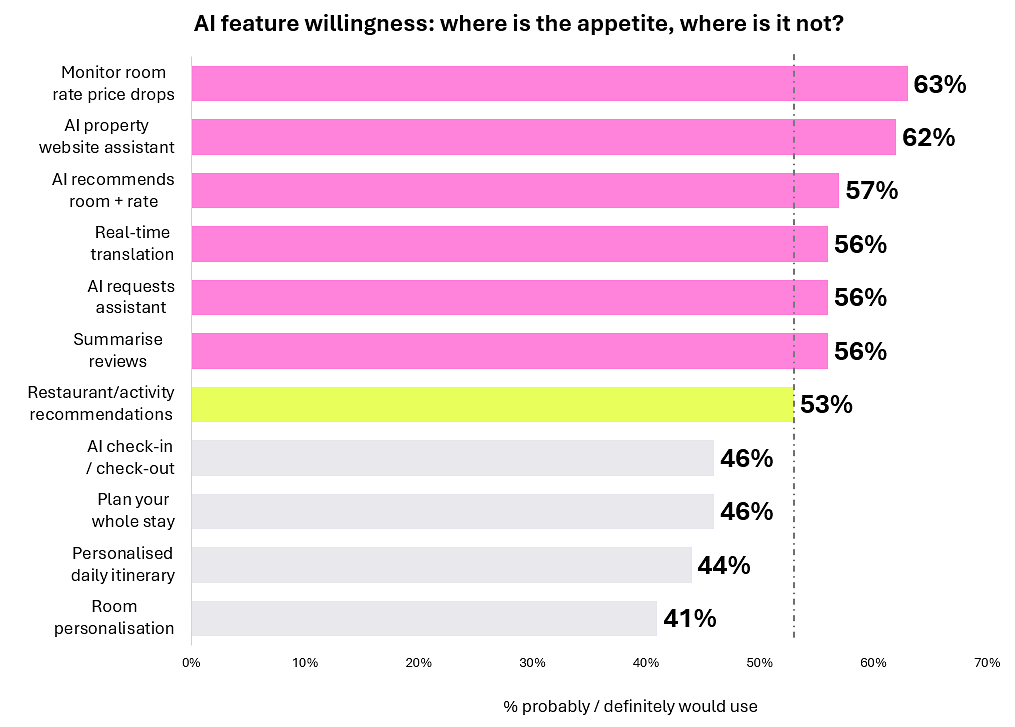
Travelers are happy to let AI watch hotel room rates and translate menus in real time, but they want to keep the wheel when it comes to itinerary planning or in-room personalization. That's the headline finding from a new Mews survey of 3,250 travelers across eight countries, published October 15, and it carries direct implications for how hospitality operators deploy AI within their property management and guest-experience stacks.
The poll found 63% of respondents would use AI to monitor room-rate price drops — essentially a yield-management alert pushed to the consumer side — and 56% would use real-time AI translation. But appetite drops sharply once AI moves from background task to front-of-house decision-maker: only 44% want AI planning their itinerary and just 41% would let it personalize their room setup. Overall, 57% say they prefer staying in control of their trip rather than delegating decisions to an automated agent.
The Data-Source Divide
The survey also surfaces a nuanced read on personalization that should inform how hotels configure their CRM and guest-data workflows. Travelers are considerably more comfortable with AI drawing on information they voluntarily provided — stated preferences (61%) and past stay history (56%) — than on passively collected signals such as browsing behavior (43%) or external social data (34%). The implication for operators is clear: consent-based data collection inside the PMS and loyalty stack is not just a compliance issue; it's a conversion lever. Spain led on transparency: 72% of Spanish respondents said they would be more willing to engage with AI-enabled services if they had explicit control over their data.
Geographic nuance runs throughout the dataset. US travelers are the most comfortable with AI referencing past stay history (63%). Italian guests lead on appetite for frictionless check-in — 58% expect arrival with no front-desk interaction versus a 42% global average — and are the most bullish on AI's role five years out (51% vs. 39% average). UK travelers, by contrast, show the most transactional mindset: only 30% rank in-stay personalization as important, compared with a 40% cross-market average.
What It Means for Operators
"Guests have told us where AI helps, and where it doesn't," said Josef Starýchfojtů, CPTO of Mews. "Having clever technology is great, but firstly, we should know whether guests want a task done for them or want to be part of it. Get that wrong and even good AI feels intrusive. We're building for human hospitality: technology handles the mundane, repetitive admin, and hotel teams have more time for their guests."
For hoteliers evaluating AI investments — whether inside a cloud-native PMS, a revenue management system, or a standalone guest-messaging layer — the survey draws a practical line. Automation earns its keep in the background: rate alerts, API-driven translation integrations, instant communication routing. It loses guest trust the moment it starts making choices guests consider personal. The hotels generating the most value from AI, the data suggests, are not those with the highest automation density but those that have mapped which moments require a human touch. That kind of intentional deployment is increasingly the differentiator in a market where hotel AI adoption is accelerating rapidly and guest expectations are evolving in parallel.
Mews powers 15,000 customers across 85 countries with a platform spanning PMS, POS, revenue management, housekeeping, and payments — giving the company a broad operational vantage point on how AI and automation reshape hospitality workflows. The survey, conducted in July 2026, covered France, Germany, Italy, the Netherlands, Spain, Sweden, the UK, and the US.
Written by Michael Politz, Author of Guide to Restaurant Success: The Proven Process for Starting Any Restaurant Business From Scratch to Success (ISBN: 978-1-119-66896-1), Founder of Food & Beverage Magazine, the leading online magazine and resource in the industry. Designer of the Bluetooth logo and recognized in Entrepreneur Magazine's "Top 40 Under 40" for founding American Wholesale Floral, Politz is also the Co-founder of the Proof Awards and the CPG Awards and a partner in numerous consumer brands across the food and beverage sector.