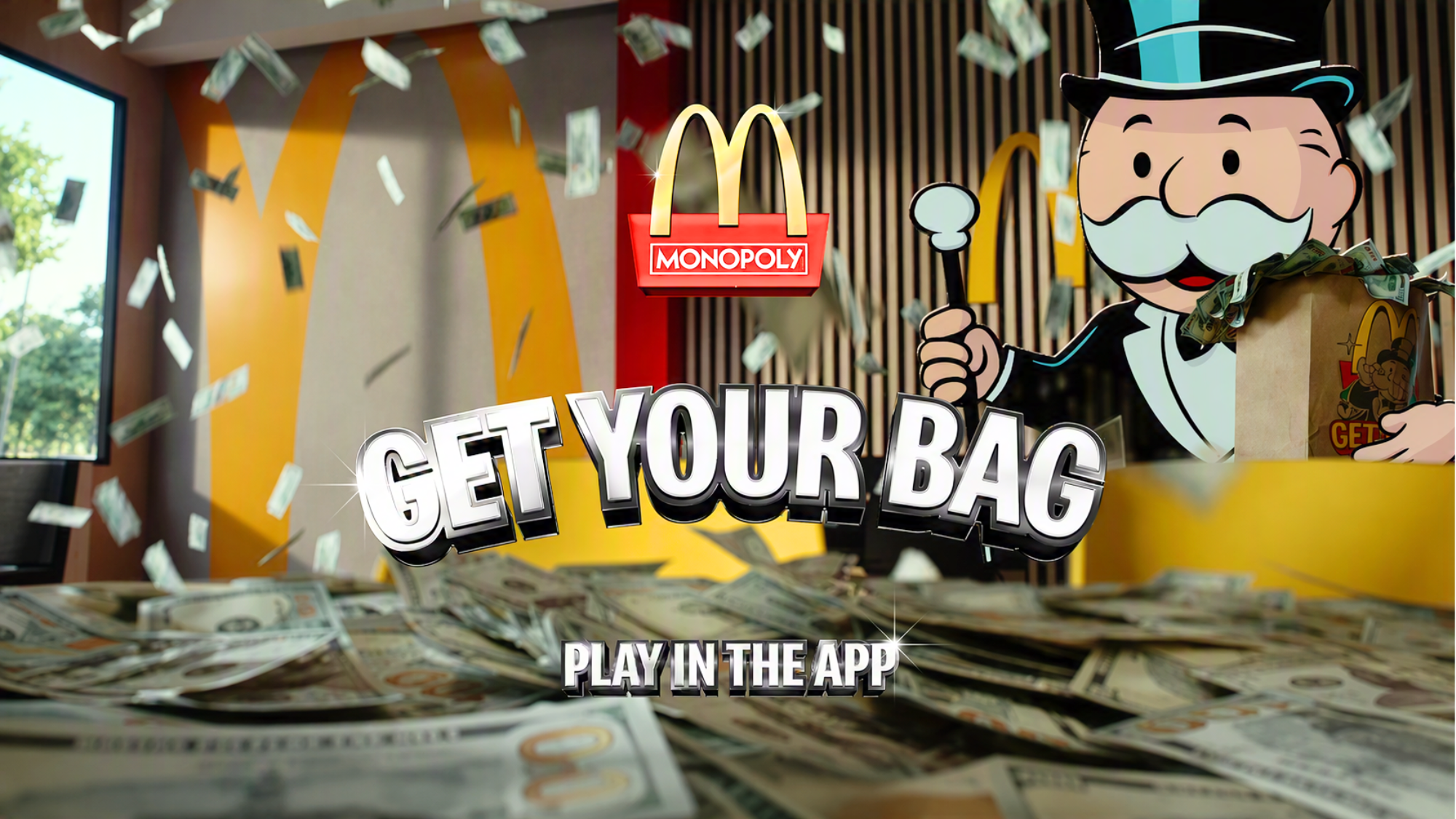
McDonald's is retooling its annual Monopoly promotion as a mobile-first loyalty play, requiring participants to scan physical game pieces inside the McDonald's app rather than redeeming prizes through paper alone. The 2026 iteration, live from Oct. 6 through Nov. 1, collapses what was previously a multi-channel redemption experience into a single in-app flow — a structural shift that hands McDonald's significantly richer first-party engagement data than the legacy peel-only format ever could.
The Loyalty Mechanics
Every game piece now feeds into one of four prize categories: instant-win food rewards, instant-win MyMcDonald's Rewards points (ranging from 1,500 to 7,000 per scan), a collect-to-win property set, and a Chance Card game triggered inside the app. Crucially, customers who order eligible items through the McDonald's app or present their Rewards code at the kiosk, counter, or drive-thru receive a bonus Chance Card play — a direct incentive to push transactions through digital channels rather than anonymous cash or card at point-of-sale. That mechanic effectively makes loyalty opt-in a prerequisite for the full promotional experience, a design pattern increasingly common among QSR loyalty programs looking to convert passive foot traffic into identifiable, marketable users.
Alyssa Buetikofer, Senior Vice President and Chief Marketing and Customer Experience Officer of McDonald's USA, framed the redesign around simplicity: "This year, we're giving fans even more reasons to play with bigger prizes, more rewards, and a simpler digital game experience that includes the classic peel." From an operator-technology perspective, the simpler UX also means a cleaner attribution loop — every scan ties a SKU, a timestamp, and a loyalty ID together in a single event.
Why the App Pivot Matters
The structural change mirrors a broader industry trend in which large QSR chains are leveraging promotional mechanics to drive mobile order adoption and loyalty enrollment simultaneously. When a customer must be opted in to MyMcDonald's Rewards and registered for the game before ordering to unlock bonus plays, McDonald's is essentially gating premium promotional value behind its CRM stack. For franchisees operating across McDonald's roughly 13,500 U.S. locations — 95% of which are independently owned — the app-first approach also reduces paper redemption complexity at the counter and streamlines prize validation, since the app handles instant-win confirmation rather than crew members adjudicating stickers.
The prize architecture itself is designed to sustain repeat visits across the promotional window. Collect-to-win property sets require multiple transactions to complete, while daily limits — up to eight game-piece code entries and eight Chance Card plays per day — create a cadence that keeps users returning to the app through Nov. 1. That sustained engagement loop is exactly the kind of behavior loyalty platforms are designed to reinforce, and it positions Monopoly less as a seasonal stunt and more as an extended loyalty and CRM activation with a promotional wrapper.
For context on how QSR chains are increasingly weaponizing promotional events as loyalty acquisition funnels, see our earlier coverage on digital ordering platform trends reshaping customer engagement strategy in fast food. The Monopoly promotion also integrates third-party gift card rewards from Grubhub and Uber Eats — both delivery platforms with their own loyalty ecosystems — adding a cross-platform dimension that could drive incremental off-premise order volume alongside in-restaurant visits.
Written by Michael Politz, Author of Guide to Restaurant Success: The Proven Process for Starting Any Restaurant Business From Scratch to Success (ISBN: 978-1-119-66896-1), Founder of Food & Beverage Magazine, the leading online magazine and resource in the industry. Designer of the Bluetooth logo and recognized in Entrepreneur Magazine's "Top 40 Under 40" for founding American Wholesale Floral, Politz is also the Co-founder of the Proof Awards and the CPG Awards and a partner in numerous consumer brands across the food and beverage sector.