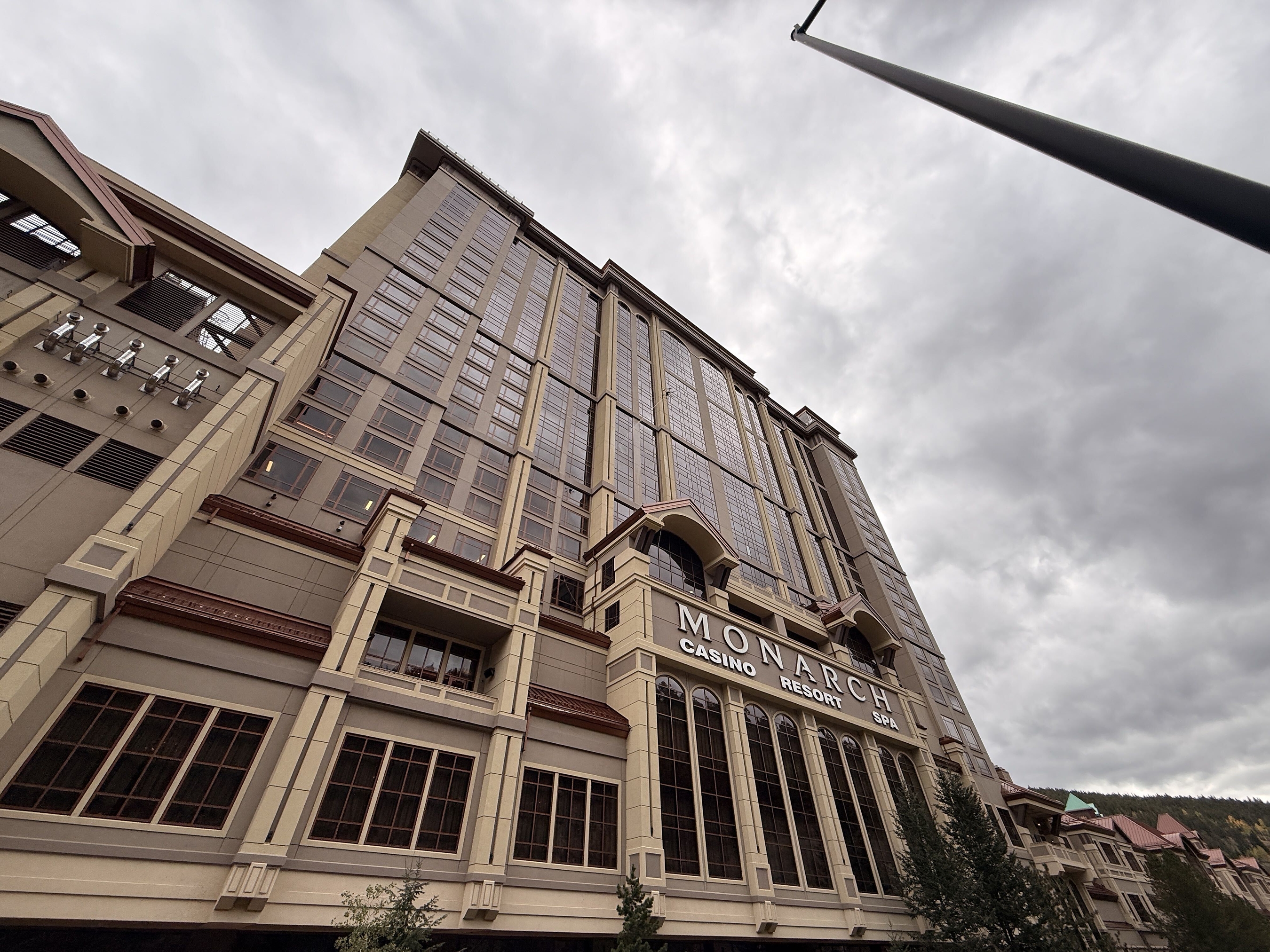
Drone cleaning company Lucid Bots set a domestic altitude record for exterior building cleaning in late September, deploying its Sherpa drone at 280 feet on the 23-story hotel tower at Monarch Casino Resort Spa in Black Hawk, Colorado. The feat was made possible by a new hardware accessory, the Sherpa HighLine — a software-controlled, motorized rooftop pulley system that transfers hose weight to a roof-mounted anchor rather than forcing the aircraft to carry it aloft.
For hospitality property operators managing mid- to high-rise assets, the development signals that drone-based exterior cleaning — already gaining traction as a labor-cost hedge and safety alternative to traditional rope-access or scaffold crews — may soon be viable for a wider range of building heights without requiring larger, more expensive aircraft.
How the System Works
The fundamental physics challenge for a cleaning drone is not simply altitude. A ground-fed drone must also support the suspended cleaning hose and the liquid inside it; as the aircraft climbs, that load compounds. Black Hawk, Colorado compounds the problem further: the mountain town sits roughly 8,000 feet above sea level, where thinner air reduces rotor lift efficiency.
The Sherpa HighLine mounts to existing rooftop equipment and feeds the cleaning hose from above, decoupling payload weight from working height. The aircraft itself is no lighter, but it carries less suspended hose mass, allowing it to reach floors that would otherwise be out of range. A secondary benefit: with hose weight managed from the roof, operators can run larger-diameter hoses that deliver higher cleaning flow — improving throughput per shift and protecting job margins by reducing time on the building.
"Supporting the hose from the rooftop changes the equation," said Robert Blank, Vice President of Research and Development at Lucid Bots. "It allows us to pursue greater working heights while also supporting larger-diameter hoses that can deliver more flow."
The Monarch Casino operation was completed in partnership with BlackJet Drone Solutions, MG Cleaning Systems, and Oklahoma Drone Technologies. Parker Eakins, owner of Oklahoma Drone Technologies, noted that conventional roof-down flight was ruled out by the site's layout, making the HighLine's bottom-up support essential to completing the 280-foot project on schedule.
Operator Economics and Market Context
For hotel and resort facility managers evaluating exterior maintenance contracts, the calculus is shifting. Drone cleaning operators increasingly compete with traditional window-washing and facade-maintenance firms by offering faster mobilization, lower insurance risk, and reduced building-access complexity. Extending the viable working envelope to taller hotel towers — a segment dominated by convention-adjacent and casino resort properties — opens a material new revenue category for drone service businesses and a new procurement option for hospitality asset managers.
Lucid Bots, backed by Y Combinator and $34 million in total funding, currently serves more than 400 operators across more than 40 states. The company has not announced a maximum certified working height for the HighLine; testing is ongoing, and final specifications will be released as development advances. Andrew Ashur, Founder and CEO, framed the Monarch Casino demonstration as a waypoint rather than a limit: "280 feet is the highest a cleaning drone has cleaned in the United States, and we're still going higher."
The Sherpa HighLine is slated for a limited release in Q4 2026, with full production targeted for early 2027. Operators can reserve a production slot with a $250 refundable deposit credited toward the purchase price, subject to operator approval and required training.
For hospitality operators tracking the broader automation and robotics trends reshaping property maintenance, or procurement teams evaluating facility-management technology for high-rise assets, the Sherpa HighLine represents a tangible step toward drone cleaning becoming standard practice on tower-format hotel and resort properties.
Written by Michael Politz, Author of Guide to Restaurant Success: The Proven Process for Starting Any Restaurant Business From Scratch to Success (ISBN: 978-1-119-66896-1), Founder of Food & Beverage Magazine, the leading online magazine and resource in the industry. Designer of the Bluetooth logo and recognized in Entrepreneur Magazine's "Top 40 Under 40" for founding American Wholesale Floral, Politz is also the Co-founder of the Proof Awards and the CPG Awards and a partner in numerous consumer brands across the food and beverage sector.